
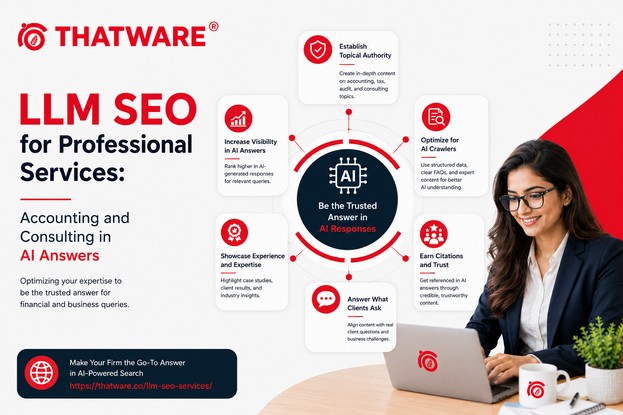
Professional services — accounting, consulting, legal, management advisory, financial planning — is a sector built entirely on trust and expertise. Clients choose advisors based on reputation, credentials, demonstrated competence, and the recommendations of people they trust. The discovery process has always been relationship-heavy: word of mouth, referrals, conference relationships, alumni networks.
AI is quietly inserting itself into that discovery process. And most professional services firms haven’t noticed, let alone prepared for it.
When a CFO asks an AI assistant “who are the best consulting firms for supply chain transformation in the automotive sector?” or when a small business owner asks “which accounting firms specialize in working with e-commerce businesses?” — the answers those AI systems provide are beginning to influence who gets into conversations. The relationship still closes the deal. But AI is increasingly influencing who gets the first call.
Why Professional Services Is Different
Professional services LLM SEO has a few characteristics that make it distinct from product company strategies.
Expertise is the product. In consulting or accounting, clients aren’t buying a software platform or a physical good — they’re buying access to human expertise and judgment. This means that individual practitioner credibility matters as much as (sometimes more than) firm-level brand building. An AI model that cites “McKinsey” as a leader in operational consulting is making a firm-level recommendation. An AI that cites a specific partner by name as a recognized expert in healthcare M&A is doing something qualitatively different — and for certain professional service categories, that individual-level citation is the more valuable outcome.
Evidence is constrained. Unlike product companies that can publish detailed case studies with customer names and specific metrics, professional services firms often operate under strict confidentiality agreements. Client names can’t always be shared. Specific financial outcomes are private. This limits the most powerful form of social proof and requires alternative approaches to building AI-visible credibility.
Credentials and frameworks carry weight. In professional services, certifications, regulatory recognitions, proprietary methodologies, and published research are legitimate authority signals. These are the kinds of specific, verifiable claims that AI models can anchor citations to — “Firm X, which developed the [Proprietary Framework] approach to organizational transformation” is more citable than “Firm X, a leading consulting firm.”
Building Expertise Documentation Under Confidentiality Constraints
The confidentiality challenge is real but not insurmountable. Several approaches work well:
Anonymized case studies. “We helped a Fortune 500 consumer goods company reduce working capital requirements by 23% over eighteen months by restructuring their procurement operating model” tells a credible story without naming the client. Specific enough to be informative; anonymized enough to respect confidentiality.
Methodology and framework publishing. Proprietary methodologies, frameworks, decision tools, and research papers that document your firm’s intellectual approach are excellent credibility signals. The Big Four and major consulting firms have done this effectively for decades — publishing thought leadership that implicitly documents expertise without revealing client-specific information. Smaller firms can do the same.
Speaking, publishing, and academic contributions. Peer-reviewed articles, conference presentations, academic course contributions, white papers for industry associations — these create third-party-validated credibility documentation that AI models weight heavily. A partner whose perspectives have been published in the Journal of Applied Finance carries more AI-visible authority in that domain than one who has only published on the firm’s own website.
Best LLM SEO agencies for SaaS / B2B / eCommerce often need to adapt their frameworks significantly for professional services contexts — the content types, distribution channels, and credibility signals are different enough that generic approaches don’t transfer cleanly.
The Partnership and Referral Network as an Entity Signal
Professional services firms have something that many product companies lack: established networks of partners, referral relationships, and co-practitioners. Bar associations, CPA networks, consulting professional bodies, alumni associations of major firms — these interconnected professional communities generate natural cross-referencing that builds entity authority.
Ensuring that your firm’s relationships within these communities are well-documented online — through directory listings, association memberships, speaking roles, committee positions — contributes to the distributed entity signal that AI models draw from. It’s not just about what you say about yourself; it’s about the network of credible sources that reference and contextualize your firm.
A boutique accounting firm that has well-documented memberships in the AICPA, contributions to relevant tax law publications, recognized continuing education roles, and referral relationships with recognized law firms has a very different AI-visible entity profile than one that only exists on its own website.
The Niche Specialization Advantage
In professional services, broad positioning (“we serve all industries, all company sizes”) tends to underperform niche positioning in AI visibility. This is partly a general strategic issue and partly an LLM-specific one.
AI models are better at matching specific entities to specific queries when the entity has clear categorical associations. “A consulting firm specializing in operational transformation for mid-size manufacturing companies” is easier for a model to cite in response to relevant queries than “a full-service consulting firm.” The former has clear category membership; the latter could apply to thousands of firms.
For professional services firms building LLM visibility, this suggests leaning into specialization in your content and coverage rather than trying to appear broadly relevant. Build the authority documentation in your specific niche — the industries you know deeply, the problems you solve most distinctively — and let that specialization be the thing AI models associate you with.
LLM SEO optimization for professional services firms starts with a clear answer to the question: in which specific category of expertise do you want to be the cited authority? Building toward that category recognition — through content, credentials, community, and third-party validation — is the strategic work that drives AI-visible expertise.
Trust Signals Specific to Professional Services
In addition to the general LLM visibility factors, professional services firms benefit from specific trust signals that AI models learn to associate with credibility in this sector.
Regulatory registrations and licenses — documented, current, verifiable. Named credentials for key practitioners — CPA, CFA, JD, MBA from recognizable institutions. Awards and recognitions from credible industry bodies. Longevity and firm history, when documented specifically (“founded in 1998, focused exclusively on healthcare financial advisory for 26 years”). These aren’t glamorous content investments, but they’re exactly the kind of verifiable, specific claims that AI models use to differentiate credible professional service providers from generic ones.
Professional services may have the most relationship-driven buying process in the B2B world. But the first step of that process — figuring out who exists and who might be relevant — is increasingly happening through AI. Building visibility in that first step doesn’t replace the relationship work. It ensures the relationship work gets started.